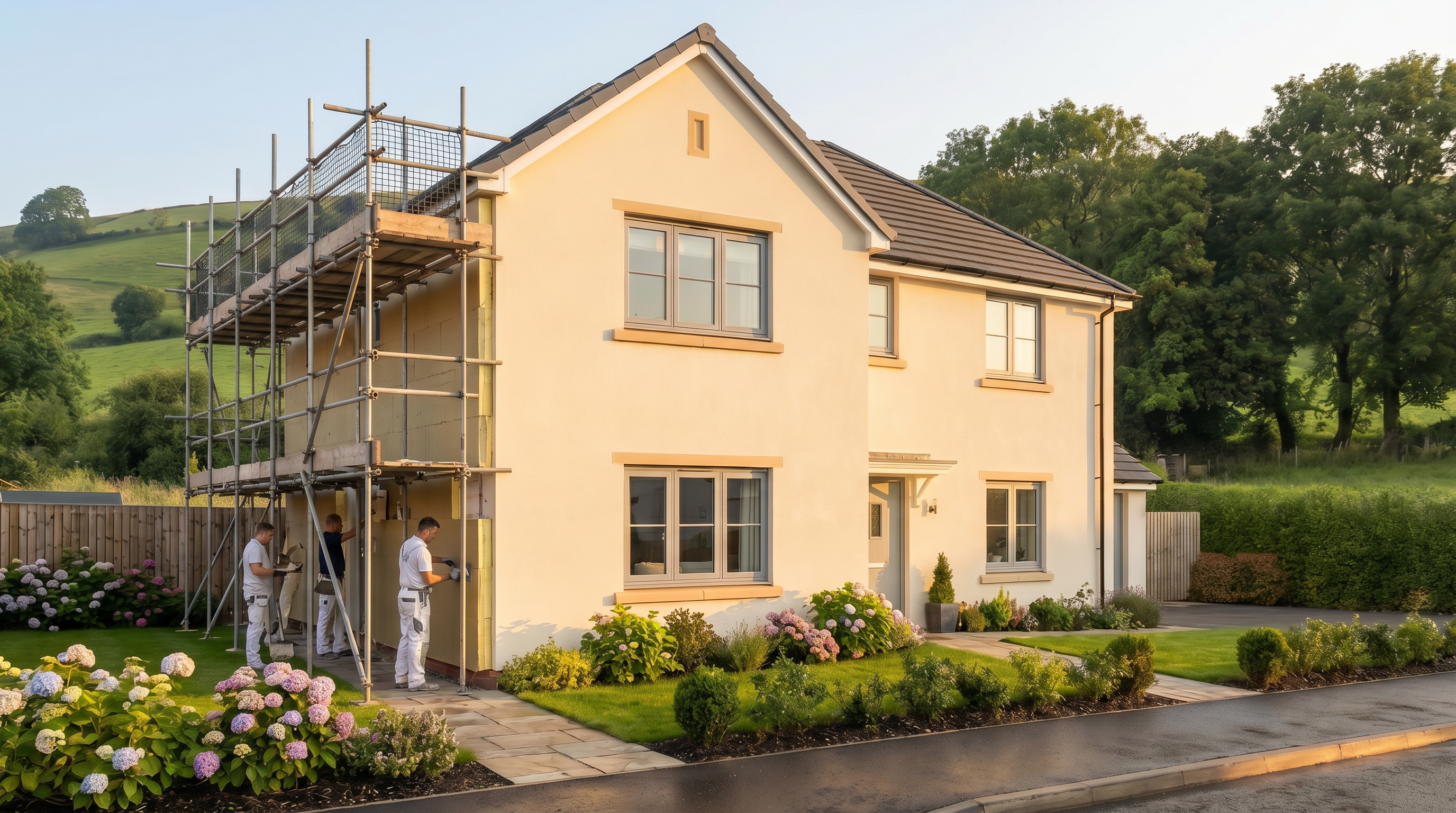
Most homeowners looking up external wall insulation costs are not really asking for a vague range. They want to know what they are actually likely to pay, what a proper quote should include, and whether a cheap or expensive price is telling them something important.
That is a fair question, because external wall insulation is a major upgrade rather than a casual home-improvement purchase. The answer depends on wall area, complexity, access, condition, and the specification being quoted, but there are still sensible 2025 ranges that help you judge the market realistically.
The point of this guide is not to replace a survey. It is to give you enough context to compare quotes properly, understand what drives cost, and avoid being misled by prices that look attractive until the detail shows what has been left out.
The short answer: what homeowners usually pay in 2025.
For a quality external wall insulation system with a premium insulation and silicone render finish, most properties land in broad ranges that reflect real differences in size and complexity rather than one universal rate.
- Mid-terrace homes often fall around £5,000 to £7,000.
- End-terrace homes often fall around £6,000 to £8,500.
- Semi-detached homes often fall around £8,000 to £12,000.
- Average detached homes often fall around £10,000 to £15,000.
- Larger detached homes can move into the £14,000 to £20,000-plus bracket.
Those are not budget-specification numbers. They reflect full systems with scaffolding, proper detailing, better-performing materials, and the sort of finish most homeowners actually expect when they want the house warmer and visually transformed at the same time.
What a proper quote should include.
A meaningful quote is not just about the insulation boards. The true cost sits across the whole system and the labour needed to make it work properly on a real house.
- Scaffolding, access setup, and dismantling
- The insulation boards themselves and the fixing system
- Base coat, reinforcing mesh, and render system
- Window reveals, corners, edges, verge details, and finishing work
- Removal and refitting of gutters, downpipes, lights, cables, dishes, and similar items
- Preparation work where the existing wall condition needs attention
If any of those items are vague, excluded, or treated as likely extras later on, the headline price may be giving a false impression of value.
Why prices vary so much between houses.
Size and wall area
The bigger the exposed wall area, the more material, time, and scaffold you need. A smaller terrace and a large detached house are not even close to the same job, so the final numbers move accordingly.
Complexity and detailing
Bay windows, multiple elevations, decorative features, awkward junctions, extensions, and lots of openings all create more cutting, more detailing, and more labour. Two houses can have similar wall area but still price differently because one is simply more involved to insulate cleanly.
Access and logistics
Restricted access, narrow passages, work over conservatories, limited storage space, or difficult scaffold arrangements all add cost. Practical site conditions matter more than many homeowners realise at quotation stage.
Existing wall condition
Some walls are ready for the system with minimal preparation. Others need repair, removal of failed finishes, or extra treatment before the installation can begin. Reputable installers price the real condition of the wall, not the ideal version of it.
Specification changes the value, not just the cost.
This is the area where the cheapest and best-value quotes start to diverge. Two installers may both say they are quoting for external wall insulation, but the products and performance can be meaningfully different.
Premium route
- Mineral wool or stone wool insulation
- Thicker boards, often around 100 to 150mm where appropriate
- Silicone render systems such as K Rend or similar
Budget route
- EPS or polystyrene insulation
- Thinner boards
- Cheaper acrylic finishes
A budget system can reduce the upfront number, but the right question is whether it is also the right fit for the property. On older solid-wall homes, breathable materials and stronger long-term finish quality matter. Cheaper is not automatically better value if the specification has been cut back in the areas that affect durability and suitability.
Per-square-metre pricing can be useful, but it can also mislead.
You will sometimes hear prices expressed per square metre. In broad terms, lower-specification systems can sit roughly around the lower end of the market, while premium mineral wool and silicone-render systems sit higher. The difficulty is that smaller properties often look expensive per square metre because fixed costs such as scaffold, setup, and detailing are being spread across less wall area.
That is why a fixed quote for your actual house is far more useful than multiplying a single square-metre rate and assuming the number will hold.
Why some quotes come in much cheaper.
- The insulation material may be cheaper and less suitable.
- The insulation thickness may have been reduced.
- The render system may be lower grade.
- Important items may be missing or treated as extras.
- The labour model may rely on less consistent workmanship or lower oversight.
A low quote does not automatically mean a bad installer, but it should trigger questions. If the number sits well below the rest of the market, find out exactly what has been changed before assuming you have found a bargain.
Why some quotes come in much higher.
- The property may genuinely be more complex than average.
- The material specification may be stronger.
- The installer may be pricing in more contingency or working from a full order book.
- The company may simply operate at a premium rate.
This is why comparison matters. One quote on its own tells you very little. Three properly comparable quotes tell you much more about what is normal, what is missing, and what is being charged for quality versus margin.
What about grants and subsidised schemes?
Grants attract attention because they promise reduced or even no upfront cost, but they also create confusion around what the work is really worth. Scheme pricing is not always a clean reflection of private-market value, and not every homeowner qualifies in the first place.
- Scheme valuations can be much higher than straightforward private pricing.
- Eligibility is limited and often tied to benefits, EPC position, or scheme rules.
- The installer and specification are not always as flexible as a private customer would want.
- Timelines can be much slower because approvals and allocation take time.
That does not mean grants are automatically wrong. It means they should be understood clearly rather than treated as a simple shortcut to a better-value job. In some cases, private installation is faster, better specified, and more predictable than partial grant-led routes.
How to compare quotes sensibly.
- Get a proper survey rather than relying on a phone estimate.
- Get at least three written quotes.
- Check the insulation material, thickness, and render specification.
- Check exactly what is included in the finishes and external-item refitting.
- Ask what happens if wall repairs or access complications are discovered.
- Judge the quote against the property, not just the cheapest number.
Is external wall insulation worth the cost?
For many cold solid-wall homes, the value argument is not just about heating-bill savings on a spreadsheet. The upgrade also changes comfort, surface temperature, condensation risk, outside appearance, and how usable the house feels through winter.
- Heating demand can reduce meaningfully when the walls stop losing heat so quickly.
- Rooms feel more comfortable because cold surfaces and cold downdraught effects are reduced.
- The outside of the house can be transformed at the same time.
- Longer-term value includes reduced maintenance pressure on tired external walls.
The right way to think about cost is therefore not only what the job costs, but what problem it is solving. On homes with persistent cold-wall issues, poor comfort, or deteriorating exterior appearance, the upgrade can do several jobs at once.
What to do next if you want a realistic figure for your own house.
The most sensible next step is to get a proper survey, compare a like-for-like specification, and then judge the quote in context. That means looking at the wall type, the access, the condition, and whether the recommendation still makes sense once your own property is taken into account.
If you are trying to compare costs, savings, and the alternative of grant routes, do not stop at the headline number. Compare the full package, the material choices, and the quality of the recommendation. That is where good value becomes visible.
After cost research, compare the real routes
Do not stop at price ranges. Use the service, proof, and survey pages to work out what is actually right for your house.
Cost-led readers are usually close to making a decision. The most helpful next step is to compare services clearly, then validate the likely route against real work and a property-specific survey.
Visit the external wall service page
If your questions are mainly about solid walls, rendering, finish, and deeper retrofit value, start here.
Check proof before you commit
Use real project pages to understand what finished work looks like and how homeowners judge the result beyond price alone.
Get a survey for your own property
The real answer depends on wall type, access, detailing, and what already exists on the house. The survey turns research into an informed decision.
Explore the wider journey
Useful next pages once the article makes sense.
Rockwarm now has a fuller service, proof, FAQ, and local-search structure. These pages help move from general education into comparison, reassurance, and a more confident commercial next step.
Compare the three main insulation routes side by side before choosing the wrong first spend.
See longer-form proof showing how service choice, property type, and finished outcomes fit together.
Read homeowner feedback and trust signals.
Check coverage across Coventry, Nuneaton, Birmingham, and the wider Midlands.
Free survey
Ready to move from reading to a real recommendation?
Guides can explain the possibilities, but they cannot confirm exactly what your own property needs. If you want advice based on the actual walls, loft, layout, and condition of your home, book a free survey and we will point you toward the most suitable next step, including when a simpler route makes more sense than a larger project.