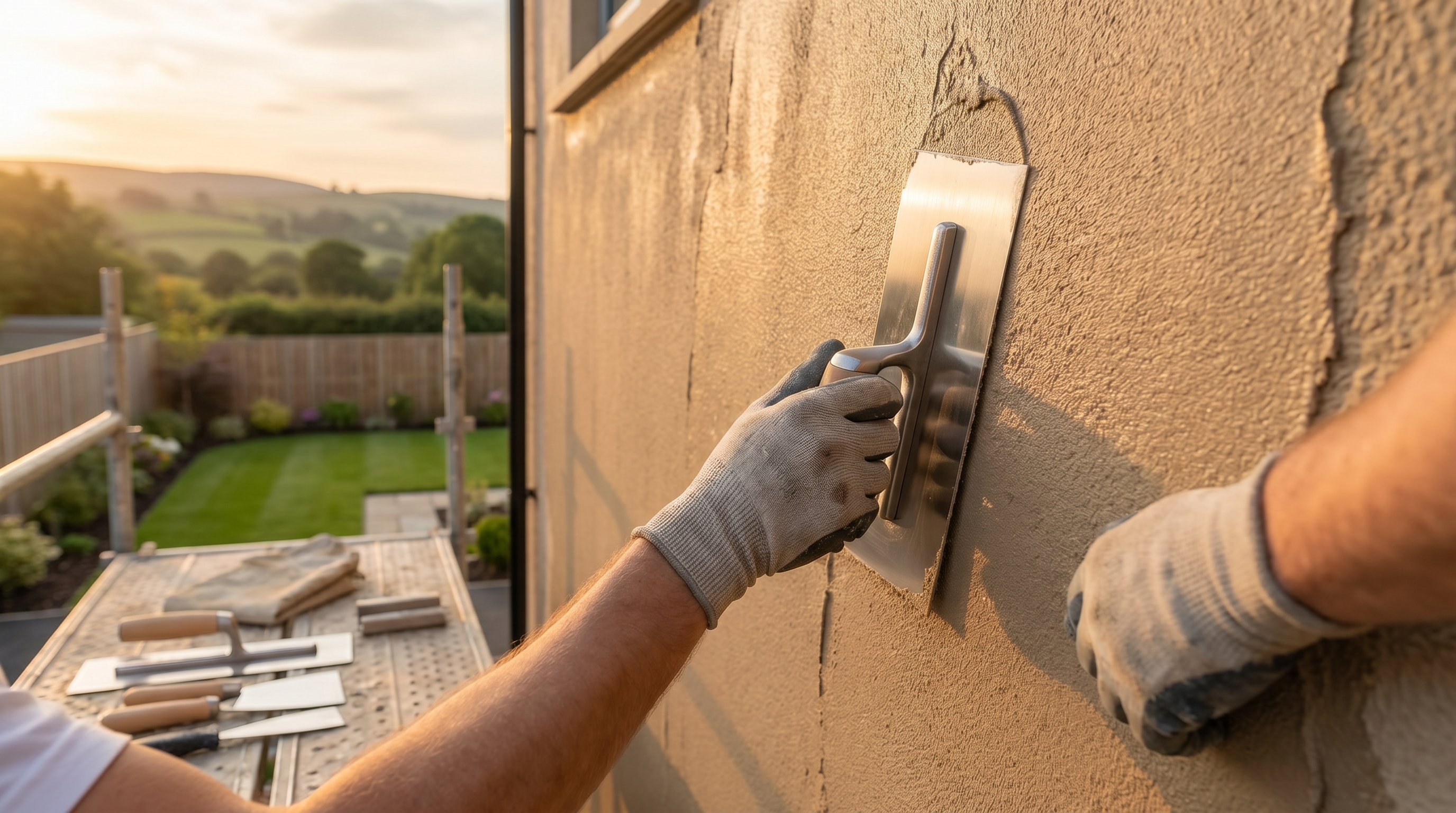
If you have been researching exterior finishes for your home, you have almost certainly come across the term K Render. Strictly speaking, the brand name is K Rend, but many homeowners search for K Render when they are trying to understand what it is, how it compares with other systems, and whether it is worth paying for on a real house rather than just in a brochure.
It attracts attention because it offers something traditional render often struggles to deliver consistently: a modern finish that looks sharp, resists weather more effectively, requires less maintenance, and can form part of a much bigger thermal upgrade when used with external wall insulation. For many properties, that combination of appearance and performance is the real attraction.
This guide explains what K Rend is, why people choose it, how it compares with other render routes, what affects cost, and when it makes sense to think of it not just as a finish, but as part of a wider improvement to the whole home.
What is K Render?
K Rend is a branded external render system widely used in the UK. One of the reasons it is so popular is that it is associated with silicone-based finishes rather than the older-style expectation of basic sand and cement render. That matters because silicone render behaves differently. It is designed to be more water-repellent, more flexible, and lower maintenance than many older render approaches people may be used to seeing on ageing properties.
For homeowners, the important point is not the chemistry in abstract terms but the practical effect. A modern silicone finish can hold its appearance better, resist weather more effectively, and reduce some of the recurring maintenance burdens associated with older render systems.
- It is known for a cleaner, more modern finished appearance.
- It is typically more resistant to weathering than old cement-based render.
- It is often chosen as the finish layer on external wall insulation systems.
Why homeowners ask for it so often.
People rarely begin by caring about render technology for its own sake. They care because they want the front and sides of the house to look better, stay smarter for longer, and justify the money they are spending. K Rend has become a recognised search term because it sits at the overlap between aesthetics, durability, and brand familiarity. Homeowners know they have seen it used on houses, extensions, and larger developments, so it feels like a known benchmark rather than an obscure specialist product.
How it compares with traditional render.
Traditional sand and cement render still shapes a lot of people’s expectations, but it can be rigid, more vulnerable to cracking, and more maintenance-heavy over time. That does not mean every traditional render installation is poor, but it does mean many homeowners who have seen ageing rendered elevations are drawn toward modern systems that promise better weather resistance and a more stable finish. K Rend’s appeal is partly that it represents a move away from the older cycle of repair, repaint, and patching that people associate with tired exteriors.
How it compares with other modern renders.
K Rend is not the only credible modern render system on the market. Other silicone-render brands are also widely specified, and a good installer should be able to discuss quality in terms of the whole system rather than pretending only one name exists. In practice, homeowners often search for K Render because it is the brand they recognise, but the better question is whether the proposed system is appropriate, well supported, and installed properly. Brand matters, but system quality and workmanship matter more.
Why K Rend and external wall insulation are often discussed together.
One of the most useful things for homeowners to understand is that K Rend is often the finish people see, while the real performance upgrade may sit beneath it. On many projects, especially older solid-wall homes, the render finish is applied over an external wall insulation build-up. That means the project is doing two jobs at once: transforming the appearance of the house and significantly improving its thermal performance.
This is why K Rend can be part of a much larger value conversation. If scaffolding, access, labour, and finishing work are already being undertaken, combining the finish with insulation can be a much more strategic decision than treating render as appearance-only work.
- The insulation layer improves comfort and reduces heat loss.
- The reinforcing and base layers support the finish properly.
- The K Rend finish gives the project its visible final appearance.
What about colours and textures?
One reason homeowners like K Rend is the flexibility around appearance. People are not limited to a single generic render look. Colour choice, tone, and texture all influence whether the house feels crisp and contemporary, soft and traditional, or more forgiving in day-to-day maintenance. Mid-tone greys and natural shades remain popular because they tend to sit comfortably across a wide range of property styles and can be easier to live with visually than brilliant whites.
The practical lesson is to choose against the house, not just from a sample chart. A colour that looks elegant on a small board can feel very different when spread across the full elevation. Good advice at survey stage is therefore as important as the sample range itself.
How much does K Render cost?
There is no single fixed price because the job is driven by property size, detailing, access, existing condition, and whether the project is render-only or part of a full external wall insulation system. The most important thing for homeowners is not to chase unrealistically low online figures. A proper job includes labour, scaffolding, preparation, materials, detailing, and finish quality. That is why serious installers survey before quoting instead of relying on broad price guesses alone.
- Wall area and complexity both affect cost.
- Access and scaffolding can materially change the price.
- Adding insulation increases the scope, but also increases the long-term value of the project.
How long does it last?
When specified and installed well, a modern silicone render finish is expected to perform for many years. Longevity depends on installation quality, exposure, maintenance, and what sits beneath the finish. The point is not that the surface will be completely untouched by time, but that homeowners are usually choosing this route because they want a more durable and lower-maintenance solution than older alternatives have given them.
What maintenance should homeowners expect?
One of the main attractions is that maintenance is relatively modest. Homeowners are not usually signing up for an endless repainting cycle. That said, low maintenance does not mean no care at all. Gutters still need to be kept in good order, staining should not be ignored if it appears, and any damage should be dealt with before it turns into a bigger issue. The finish performs best when the rest of the building is also looked after sensibly.
When is it a strong fit for a property?
K Rend works especially well where a homeowner wants appearance improvement and practical performance at the same time. That may be on an older solid-wall house needing insulation, on a property with a tired or patchy existing exterior, or on a home where low-maintenance ownership matters. It can also be attractive where the goal is to modernise the look of a house without moving into cladding or more radical exterior redesign.
When might it not be the right route?
It is not automatically right for every building. Listed properties, conservation settings, and homes where exposed brick is central to the character may point in a different direction. Budget also matters. A quality K Rend installation is not the cheapest route, and homeowners should be wary of treating premium-looking finishes as something that can be installed well at bargain-basement prices. If the brief is wrong, or the budget only supports a compromised version of the job, another approach may be wiser.
How to judge an installer.
The finish is only as good as the team specifying and applying it. Homeowners should ask about experience, examples of completed projects, what is included in the quote, who carries out the work, and what guarantees are offered. A clear survey and a detailed quotation usually tell you far more about likely quality than a flashy gallery on its own.
- Ask whether the quote is for render only or a full insulated system.
- Ask what preparation and detailing are included.
- Ask to see real examples of completed local work.
- Ask what guarantee applies to workmanship and materials.
The practical takeaway.
K Render is popular for good reasons. It gives homeowners a modern, durable-looking finish and can play an important role in a much bigger external wall insulation upgrade. The right question is not just whether the brand is well known, but whether the proposed system, colour, specification, and installer all make sense for your property and your goals.
If you are exploring it seriously, the next step should be a proper survey rather than more guesswork. That is how you move from admiring finishes online to understanding whether this route is actually right for your house, your walls, and the level of finish you want to live with for years to come.
Turn reading into the right next step
Use the advice, then move into the pages that answer your own property questions.
Educational content helps you understand the issue, but the next commercial step is usually to compare the most likely service, check proof from real homes, and then ask about your own property with confidence.
Compare the main insulation routes
Use the service pages to narrow whether external wall, cavity wall, or loft insulation looks like the strongest first route for your home.
Check real proof before deciding
Move from theory into before-and-after work, customer feedback, and project stories so the advice feels grounded in finished outcomes.
Ask about your own property
Once you understand the issue, the survey is the fastest way to turn general reading into a property-specific recommendation.
Explore the wider journey
Useful next pages once the article makes sense.
Rockwarm now has a fuller service, proof, FAQ, and local-search structure. These pages help move from general education into comparison, reassurance, and a more confident commercial next step.
Compare the three main insulation routes side by side before choosing the wrong first spend.
See longer-form proof showing how service choice, property type, and finished outcomes fit together.
Read homeowner feedback and trust signals.
Check coverage across Coventry, Nuneaton, Birmingham, and the wider Midlands.
Free survey
Ready to move from reading to a real recommendation?
Guides can explain the possibilities, but they cannot confirm exactly what your own property needs. If you want advice based on the actual walls, loft, layout, and condition of your home, book a free survey and we will point you toward the most suitable next step, including when a simpler route makes more sense than a larger project.